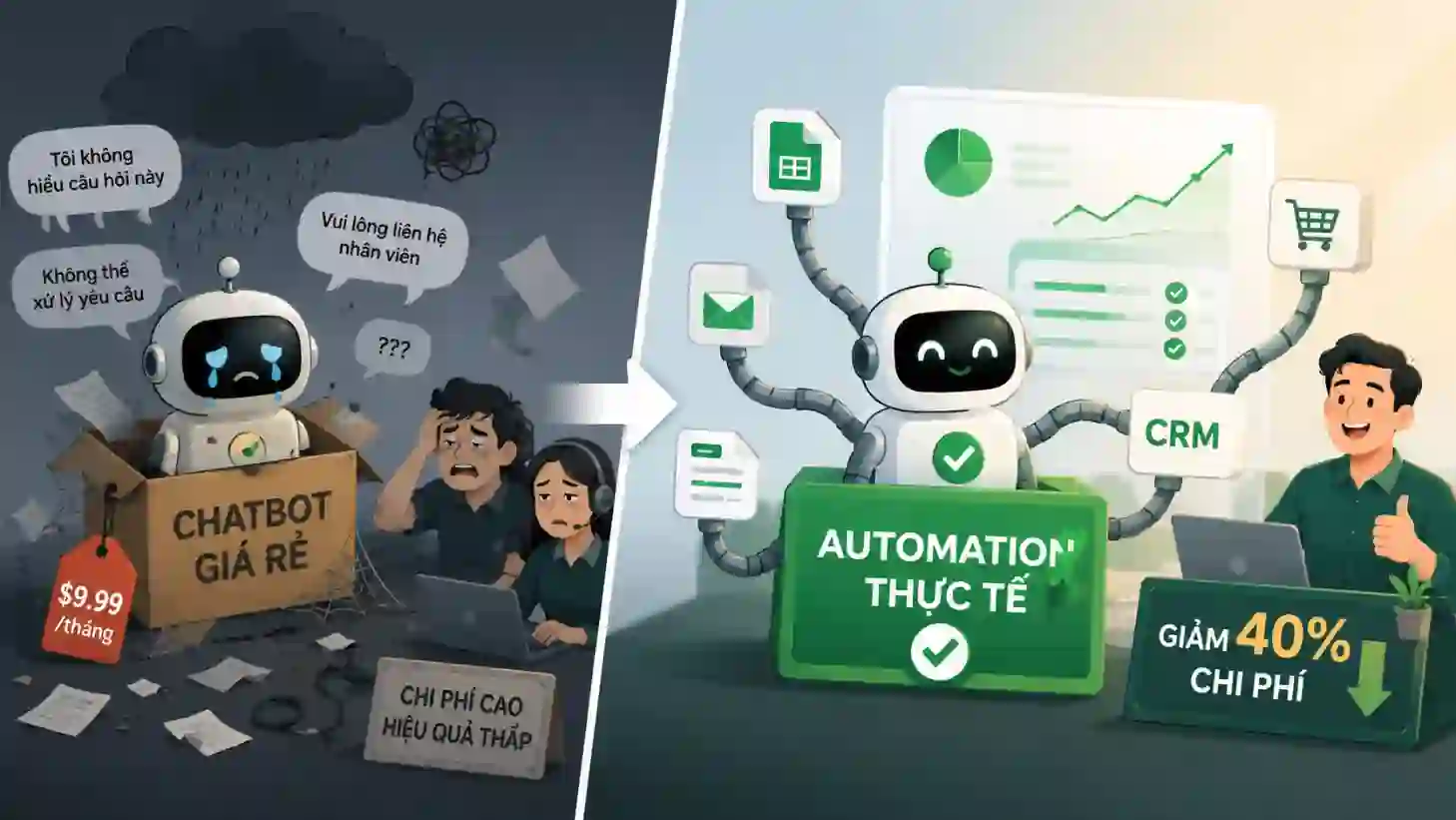
Short answer: SMEs shouldn't pay for a chatbot just to "have AI". AI is worth the money when it automates the repetitive process that eats the most staff hours — reading invoices, sorting emails, filtering out the leads who actually want to buy — and is measured by the cost and handling time it removes. Start from that one task, use AI as an assistant rather than a replacement, and ground it in your own business data.
Lately, I hear people talking about AI everywhere. "AI will change the world," they say, or "Businesses that don't use AI will die."
The result? Many SME business owners rush to buy cheap AI Chatbot packages or hire advertising agencies to "attach AI" to their websites just for show. But after a week, they exclaim: "Get rid of it, Chau! It answers customers like a machine and often says things that frustrate them!"
The truth is: AI is not magic. It's a sharp knife; if you don't know how to hold the handle, you'll cut yourself.
As a Manager who understands Tech, I want to share a realistic perspective on using AI for SMEs so that it makes money instead of generating junk.
TL;DR (Executive Summary)
- Problem: Many SMEs spend on cheap chatbots just to "have AI" but never reduce operating cost.
- Solution: Shift focus from chit-chat to automating the most labor-heavy process and measure the effect through cost and processing time.
- Outcome: Manual workload and processing time fall materially, with AI tied to an operational result rather than a chatbot demo.
"AI for Show" vs. "Value-driven AI"
There is a huge difference between installing a bot to "reply automatically" and building an AI Automation system.
Most cheap chatbots today are just "parrots." They repeat pre-written answers. When customers ask more complex or subtle questions, they start to stumble and give nonsensical answers.
Realistic (Value-driven) AI must be something that helps you:
- Reduce manual workload: For example, automatically extracting information from invoices, automatically classifying customer emails, or automatically reminding about appointments.
- Support decisions: AI analyzes which customers are the most potential so that sales staff can focus on taking care of them.
- Personalize the experience: AI remembers what this customer likes and suggests exactly that.
A Lesson from Chau's Insurance Project
I used to work for an insurance system. The volume of paperwork and claims every day was enormous. If every file were reviewed by hand, the operating costs would "eat up" all the profits.
I didn't use a chatbot to chit-chat with customers. Instead, I built an AI system to:
- OCR (Image Recognition): Automatically read information from the medical records customers sent up.
- Auto-classification: The AI checked whether the file was eligible for compensation.
- Risk Warning: The AI pointed out files with signs of fraud.
The result: operating costs and processing time fell materially because the system removed repetitive manual handling. That is the real power of AI.
📐 To understand how this three-tier AI architecture controls hallucination risk at a strict enterprise grade, see the deep-dive: Custom RAG for Enterprises — A 3-Layer Hallucination-Control Architecture.
The True Nature of AI Automation for SMEs
Many small and medium-sized enterprises (SMEs) mistakenly believe AI Automation is about buying a smart Chatbot or using Midjourney to generate images automatically. In reality, the core value of AI Automation for SMEs lies in Data Flow. Specifically:
- Data Collection: Using OCR (image recognition) to automatically read invoices instead of manual data entry.
- Logical Decision Making (AI Parsing): Using AI to categorize customer emails to see who is complaining and who is asking for a quote.
- Automated Execution: Connecting APIs to push that data into a CRM, or automatically triggering a response email flow. You don't need a sentient AI (AGI). What you need is an unthinking but strictly compliant machine to free your employees from repetitive copy-paste tasks.
The right order: standardize, digitize, then automate
To successfully implement AI Automation (and avoid the costly automation failures I've been through), follow the 3 standard steps of an architectural engineer:
- Standardize the process: Write your current process down on paper. If you can't describe the workflow using a flowchart, AI cannot learn it either.
- Digitize: Move everything onto digital platforms. Data must be clean and stored systematically (Database) rather than scattered across personal chat apps.
- Automate with AI: Only when you have clean data and a standard process should you plug AI modules into the exact "joints" that are slowing human speed.
Choosing the right tool (N8N, Make, Zapier, or custom API coding) will depend on your budget and specific business problem. Don't buy a sledgehammer to crack a nut.
Where should SMEs start using AI?
Don't dream about far-off things like "replacing humans." Start with these 3 steps:
Step 1: Identify "Repetitive Tasks"
List the tasks that your employees have to do repeatedly every day and find most tedious. That is exactly where AI should jump in. (Important: don't start with AI, start with the process — automating a messy process only creates "automated chaos".)
Step 2: Use AI as an "Assistant," not a "Replacement"
Let AI draft emails, summarize meeting content, or suggest consultation scripts. Your employees will be the final reviewers. This ensures the "human" touch in your service.
Step 3: Chatbots must have "Business Knowledge" (RAG)
If you want to use a Chatbot for consultation, don't use the free version. Use RAG (Retrieval-Augmented Generation) technology — which means you "feed" all of your company's documents and knowledge to the AI. Then it answers from your own documents, and hands anything they don't cover to a person.
Chau's Final Advice
AI in 2026 is extremely powerful, but it still needs a good Architect to set it up.
Three things decide whether an AI project actually works:
- Logic is King: AI is more than just a chat bubble; it's the data workflow behind it. Whoever designs the workflow has to understand the business, or the bot answers wrongly. I design the data architecture myself so the AI stays close to your business rules.
- No Generic Templates: Every business has unique pain points. I build tailor-made solutions instead of selling generic chatbot packages.
- Agile Fine-tuning: AI needs constant "training." If every change to a bot's answer has to pass several approval layers, the bot falls behind the business. Working with me directly removes those layers.
I'm currently working full-time, but I still set aside time to share what I've learned. If you're wondering whether AI really fits your process (or you've already had bad experiences with automation), feel free to drop me a message. I'll share my honest take — I'm not here to sell AI, just to share what I've been through.
AI should make your life easier, not more complicated.
Nguyen Chau
Delivery Manager
14 years of Delivery experience (Web, Systems, AI Automation) for VN/JP markets
JLPT N1 / PMP® Certified

Frequently Asked Questions
How do I know if my business actually needs AI?
Ask three questions: is the process repetitive, is the volume large enough, and is the output measurable. If any one is missing, AI is usually a cost rather than a profitable investment.
Will a cheap chatbot reduce my costs?
Rarely. A chit-chat chatbot is not tied to a concrete process, so it does not replace labor hours. Real savings come from automating high-volume repetitive tasks, like the insurance case in this article.
Where should an SME start with AI automation?
Start by mapping your current process and data flow to find the most repetitive bottleneck, not by choosing an AI tool. AI only creates value when attached to a process with clear inputs and outputs.
Why do so many SME AI projects fail?
Because the business buys technology before understanding the operational problem. When the process is fragmented and data is not standardized, AI just automates the chaos faster instead of cutting cost.
