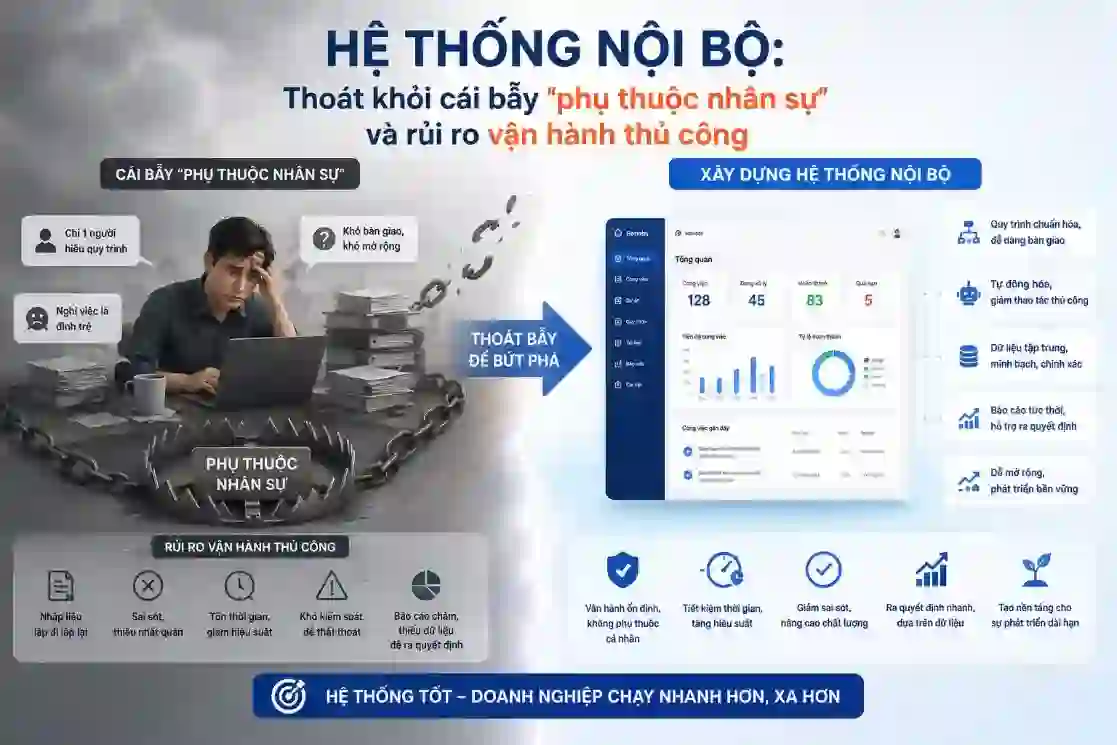
- Problem: The bigger a business gets, the more it can collapse when processes live only in a few key employees' heads.
- Solution: Move from fragmented manual operations to a centralized, handoverable "Source of Truth" system.
- Outcome: Reduced people-dependency risk; the process exists independently of whoever runs it.
"Chau, my chief accountant suddenly resigned, and now no one knows where the debt tracking Excel file is, nor does anyone understand the formulas for calculating discounts in it..."
This is a typical "firefighting" call I receive from business owners. The problem isn't the accountant leaving; it's that the entire operational knowledge of the business resides in the head (or personal files) of one person.
In my 14 years as a Delivery Manager for Japanese and Vietnamese clients, I've realized this is the most dangerous "trap" for SMEs: The Human-Dependency Trap.
TL;DR (Executive Summary)
- Problem: SME businesses easily fall into the "human-dependency trap" where operational processes and data live only in a few individuals' heads or scattered Excel files, causing error risks and bottlenecks during scaling.
- Solution: Build an internal system that acts as a "Source of Truth", focusing on data standardization, workflow automation, and real-time reporting instead of buying generic off-the-shelf software.
- Outcome: Processes exist independently of the operators, manual errors are minimized, hidden costs are optimized, and a solid foundation is established for digital transformation and business expansion.
1. The Pain of "Fragmented Processes"
When a business is small (3-5 people), communicating via WhatsApp/Zalo or using scattered Excel files is normal. But when you scale to 20-50 people, this fragmentation becomes "poison":
- "Chinese Whispers" Data: Sales reports one price, the warehouse reports another quantity, and accounting records it differently. No one knows which is the final number (Single Source of Truth).
- Manual Error Risks: A single misclick in an Excel file can lead to payroll or quotation errors worth thousands of dollars.
- Slow Response Time: Need a weekly revenue report? Staff spend 2 days "massaging" data from 5 different files.
2. Analysis: Why "Manual Operation" is Expensive
Many business owners think: "Hiring one more data entry clerk for $500/month is still cheaper than investing in a system for $10k".
This is a numerical fallacy.
Consider the hidden costs:
- Opportunity Cost: Your best employees spend 4 hours a day copying and pasting data instead of finding new customers.
- The Cost of Mistakes: A single error in a quotation can destroy a major client's trust. This cannot be measured by salary.
- "Brainwashing" Cost: When an old employee leaves, you lose 2-3 months training a newcomer just to understand the old one's "private logic."
Conclusion: Manual operation is not cheap; it's an "installment" cost with a predatory interest rate paid in your business's stability.
3. The Solution: Building a "Source of Truth" System
A good Internal System doesn't need to be a giant ERP; it needs to be a "Central Brain":
- Data Standardization: All information entering the system must follow common rules. No more inconsistent date formats or different ways of writing customer names.
- Workflow Automation: When Sales clicks "Close Deal," the warehouse automatically gets a packing notice, and accounting automatically receives an invoice request. No phone calls or reminders needed. (Automating the right way is harder than it looks — I recounted the times I got it wrong in Automation fail: hard-won lessons.)
- Real-time Reporting: The owner opens a Dashboard and sees the cash flow immediately, without waiting until the end of the month.
4. Advice: Where to Start?
Don't try to build a perfect system all at once. Start with the biggest pain point:
- Struggling with inventory? Build an inventory and barcode management system.
- Struggling with payroll and KPIs? Build a task tracking system.
- Struggling with customer care? Build a CRM tailored to your specific process.
Important Note: Whether to buy off-the-shelf SaaS or build a custom system is a decision worth thinking through carefully. Don't buy overly complex "off-the-shelf" software if your process is unique. A custom-built system that fits 100% of your workflow is the only way staff will actually use it. But "custom-built" can also hit a dead end if you pick the wrong partner — I break this down in Why outsourced IT projects so often fail.
What I've learned through experience
After years building systems for Japanese corporations (where process discipline is paramount), my takeaway: escaping the "people-dependency trap" isn't about having code — it's about operational design:
- Audit current processes: Find the bottlenecks slowing down your machine — this is system thinking in practice.
- Design data architecture: Ensure the system can scale when your business grows 10x.
- Custom implementation: Build exactly what's needed — nothing more, nothing less — easy to use even for non-tech-savvy staff.
If your business feels "suffocated" by Excel and manual processes, feel free to drop me a message. I'll share what I've been through — sometimes two perspectives is all it takes to spot the way forward.
Nguyen Phuc Nguyen Chau
Delivery Manager
14 years of Delivery experience (Websites, Systems, AI Automation) for the VN - JP markets

Frequently Asked Questions
Why is dependence on staff such a big risk?
When a process lives only in one person's head, the business loses the ability to operate the moment they leave, fall ill, or get overloaded. It is a hidden operational risk that does not show on reports until it breaks.
What is a "Source of Truth" system and how do I start?
It is a single place that stores data and standard processes so everyone references the same truth. Start with the most critical process that currently depends on one individual, standardize it, then expand gradually.
