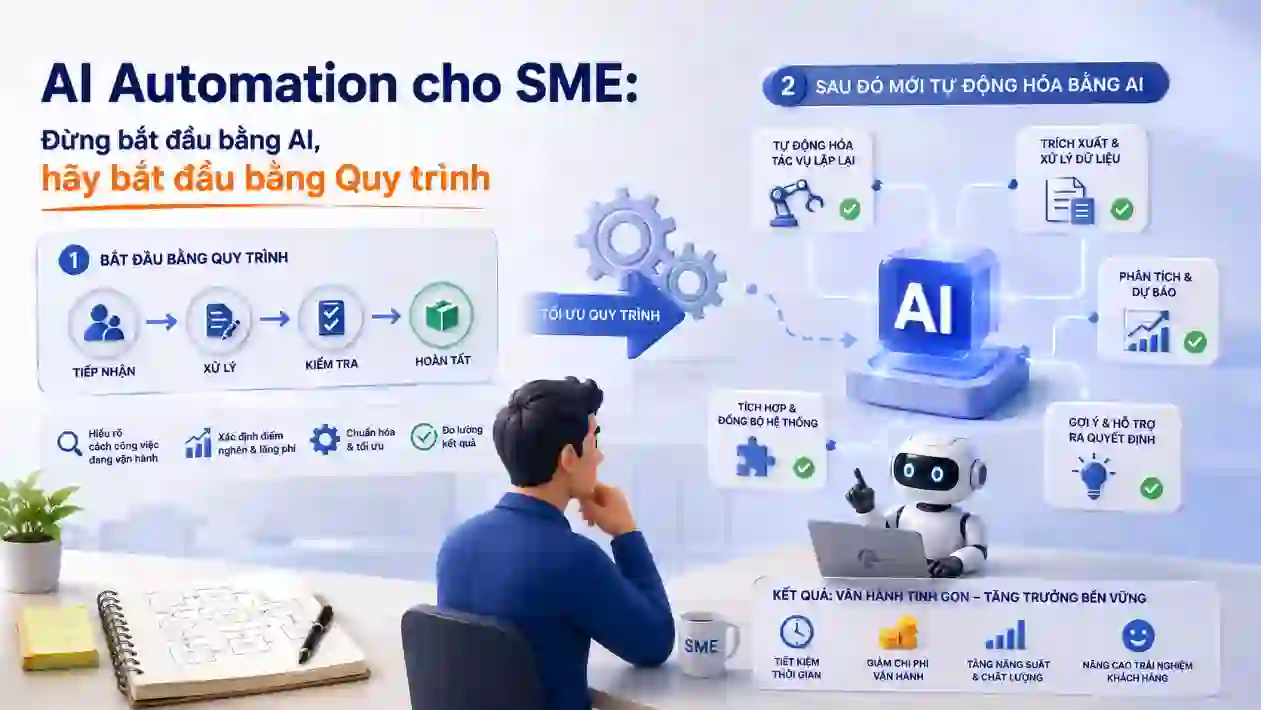
- Problem: SMEs buy AI tools to follow the trend but get no value because they never map their data flow and current process first.
- Solution: Redraw the data flow, isolate the three most repetitive operational bottlenecks, then place AI exactly where it adds value.
- Outcome: Automation targets real value points instead of burning budget on AI that is not tied to an actual process.
Last year, a retail business owner contacted me with a request: "We want to integrate ChatGPT into our website to automatically close sales instead of using staff." When I asked what their staff's current sales process looked like, he replied: "Each person chats via Zalo on their own, the inventory file is kept on a Google Sheet, and they often forget to update it, leading to selling out-of-stock items." This is a classic example of: Jumping straight to an AI solution when the foundational process is broken. As a System Architect specializing in operational problems, I always emphasize to my clients: AI Automation is not a magic wand to fix a bad process. If you automate a chaotic process, you just create "automated chaos."
TL;DR (Executive Summary)
- Problem: Many SMEs follow the hype, blindly purchasing AI tools without generating real value because they haven't standardized their current data flows and operational processes.
- Solution: Instead of starting with AI, map out the entire data flow, identify and isolate the 3 most repetitive operational bottlenecks, and only then integrate AI exactly where it is needed.
- Outcome: Accurately automate the points that generate the highest value, optimize costs, and avoid "burning money" on AI solutions disconnected from the business's actual processes.
1. The True Nature of AI Automation for SMEs
Many small and medium-sized enterprises (SMEs) mistakenly believe AI Automation is about buying a smart Chatbot or using Midjourney to generate images automatically (I wrote about how to pick AI for SMEs without wasting money). In reality, the core value of AI Automation for SMEs lies in Data Flow. Specifically:
- Data Collection: Using OCR (image recognition) to automatically read invoices instead of manual data entry.
- Logical Decision Making (AI Parsing): Using AI to categorize customer emails to see who is complaining and who is asking for a quote.
- Automated Execution: Connecting APIs to push that data into a CRM, or automatically triggering a response email flow. You don't need a sentient AI (AGI). What you need is an unthinking but strictly compliant machine to free your employees from repetitive copy-paste tasks.
2. Three Common Bottlenecks AI Can Solve Immediately
Instead of pouring money into visionary systems, start "stress-testing" AI at your most severely congested points:
A. Customer Service Triage
The Problem: 80% of customer questions are repetitive (asking for prices, delivery times). Customer service staff are exhausted answering them. The AI Solution: Integrate a RAG (Retrieval-Augmented Generation) flow so AI can read directly from your internal company knowledge base and answer basic questions. Human staff only step in to handle the difficult 20%.
B. Data Entry Automation for Documents
The Problem: Accountants spend 3 hours a day retyping information from paper/PDF invoices into Excel software. The AI Solution: Build a Workflow with Make/Zapier combined with AI Vision. Forward an invoice to a Slack/Zalo channel → AI automatically extracts the Tax ID, Amount, Date → Automatically pushes it into your Accounting software. (Zero Data Entry).
C. Instant Operational Reporting
The Problem: The boss needs to see revenue, but staff spend half a day aggregating it from multiple files. The AI Solution: Sync data to a Single Source of Truth (SSOT). Use AI to query data using natural language: "Show me this month's revenue compared to last month for Branch A". The Dashboard will instantly plot the chart.
3. Where to start without burning cash?
To successfully implement AI Automation (and avoid the costly automation failures I've been through), follow the 3 standard steps of an architectural engineer:
- Standardize the process: Write your current process down on paper. If you can't describe the workflow using a flowchart, AI cannot learn it either.
- Digitize: Move everything onto digital platforms. Data must be clean and stored systematically (Database) rather than scattered across personal chat apps.
- Automate with AI: Only when you have clean data and a standard process should you plug AI modules into the exact "joints" that are slowing human speed.
Choosing the right tool (N8N, Make, Zapier, or custom API coding) will depend on your budget and specific business problem. Don't buy a sledgehammer to crack a nut.
If your company has repetitive processes that consume too much time but you aren't sure how to apply technology effectively, you can submit your system case to me. We will review your operational workflow (Workflow Audit) together before deciding whether to invest in AI.
Nguyen Chau
Delivery Manager / System Architect
14 years of experience delivering architecture and systems for the VN-JP market

Frequently Asked Questions
Where should an SME start with AI automation?
Start by mapping your current process and data flow to find the most repetitive bottleneck, not by choosing an AI tool. AI only creates value when attached to a process with clear inputs and outputs.
Why do so many SME AI projects fail?
Because the business buys technology before understanding the operational problem. When the process is fragmented and data is not standardized, AI just automates the chaos faster instead of cutting cost.
