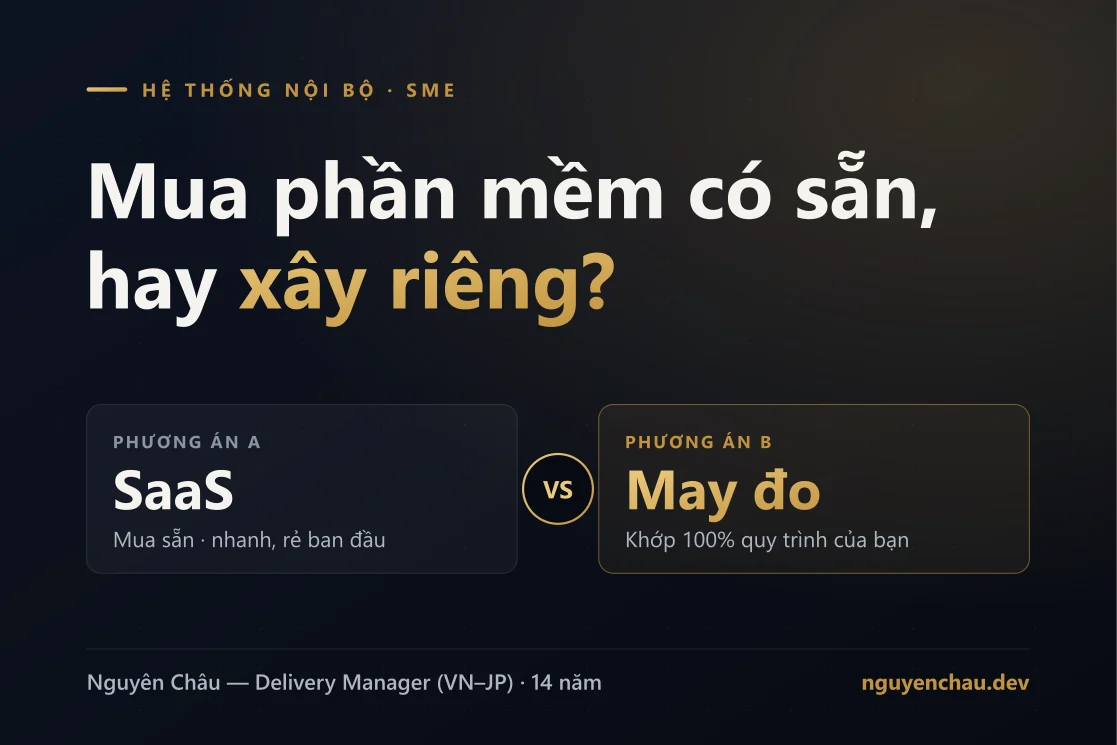
- Problem: SMEs hesitate between buying off-the-shelf software (SaaS) and building custom, and a wrong pick can cost 6-12 months.
- Solution: A cost/speed/fit comparison table plus a 4-question framework to decide Build vs Buy yourself.
- Outcome: Decisions based on your process specifics instead of gut feel, reducing the risk of going the wrong way.
In 14 years as a Delivery Manager for the Vietnam–Japan market, the question I hear most from SME owners isn't "which technology is best?" — it's something far more grounded:
"Chau, should I just buy off-the-shelf software to move fast, or hire someone to build it custom so it actually fits?"
This is the classic Build vs Buy problem. Pick the wrong direction up front and you don't just lose money — you lose 6–12 months and your team's faith in "digital transformation." This article is the framework I use to help businesses decide, with no bias either way.
TL;DR (Executive Summary)
- Problem: SMEs hesitate between buying off-the-shelf software (SaaS) and building custom, and a wrong pick can cost 6-12 months.
- Solution: A cost/speed/fit comparison table plus a 4-question framework to decide Build vs Buy yourself.
- Outcome: Decisions based on your process specifics instead of gut feel, reducing the risk of going the wrong way.
SaaS vs custom software: what's the difference?
Before comparing, let's define the terms:
- SaaS (Software-as-a-Service): ready-made software you pay for monthly/yearly (packaged CRM, accounting, sales tools). You share one product with thousands of other businesses.
- Custom-built software: a system designed specifically around your operations. You own the business logic instead of bending yourself to a vendor's mold.
Neither is universally "better." There's only what fits your stage and how unique your processes are.
Quick comparison: SaaS vs Custom
| Criteria | SaaS (buy) | Custom (build) |
|---|---|---|
| Upfront cost | Low, paid monthly | High, one-time investment |
| Time to launch | Fast (days–weeks) | Slower (weeks–months) |
| Process fit | You bend to the software | Fits your workflow 100% |
| Scalability | Capped by plan/vendor | Whatever you design |
| Vendor dependency | High (vendor lock-in) | You own it |
| Long-term cost | Grows per user/feature | More stable once built |
| Integration | Limited to vendor's API | Proactive (API-first) |
The table reveals one truth: SaaS is cheap and fast early, but gets expensive as you grow and your processes get more specific. Custom is the reverse.
When should you choose SaaS?
Buy off-the-shelf if most of these are true:
- Your process is standard, nothing too unusual (accounting, email marketing, basic time tracking…).
- You need to run this week, with no large budget yet.
- Your team is small, user count is low, subscription cost is negligible.
- Your problem is already well-solved by the market — no need to reinvent the wheel.
Blunt advice: don't custom-build what a $5/month tool already does well. That's waste.
When should you build custom software?
Consider investing in your own system when:
- Your operational process is a competitive advantage — and SaaS forces you to change it.
- You've hit the limits of Excel/Google Sheets, and scattered SaaS tools can't "talk" to each other.
- Per-seat SaaS subscription costs are ballooning as your team grows.
- You need a single Source of Truth instead of data scattered everywhere. I covered this trap in depth in Internal systems: escaping the human-dependency trap.
The clearest sign to "build": when your staff spend hours each day copy-pasting data between tools — that's when the hidden cost of fragmented SaaS has already exceeded the cost of one clean system.
Common traps in this decision
From the projects I've "rescued," a few mistakes repeat:
- Buying SaaS then forcing the business to bend to it — staff quietly go back to parallel Excel files, and data gets messier.
- Building custom too early — when the process isn't stable yet, the system is obsolete before it ships.
- Picking the wrong build partner — the biggest risk. A custom project given to the wrong people becomes a "tangled mess of code" nobody can maintain. I break this down in Why outsourced IT projects so often fail.
- Forgetting the humans — even with automation, if you don't design for real users, the system gets abandoned. I paid for this lesson, recounted in Automation fail: hard-won lessons.
A 4-question framework to decide for yourself
When consulting, I always return to these four questions — answer them honestly and the direction becomes clear:
- Is this process a competitive advantage? If yes → lean custom. If no → SaaS.
- Does SaaS force you to change how you fundamentally work? If yes → custom. If no → SaaS.
- What's the 3-year subscription cost vs. a one-time build? Include hidden costs (time, manual errors).
- Do you have someone trustworthy to build and maintain it? If not → don't rush to build, or find the right person who's accountable to the end.
Often the best answer isn't "all SaaS" or "all custom," but a hybrid architecture: SaaS for the commodity parts, custom for the core that creates your advantage — connected via APIs.
Conclusion
Build vs Buy isn't an ideological war. It's an architecture problem: putting your money and effort where they create lasting value.
Starting from the right architectural thinking — analyzing your process, identifying the core to own vs. the parts to outsource — matters far more than quickly picking a tool. And if your conclusion leans toward Build, the next step should be estimating your system budget yourself before asking for quotes — so the quotes you receive are actually comparable (you can use the quick 5-cost-variable estimator). If you're standing at this crossroads and want a straight perspective on your specific case, feel free to get in touch.
Nguyen Phuc Nguyen Chau
Delivery Manager
14 years of Delivery experience (Websites, Systems, AI Automation) for the VN - JP markets

Frequently Asked Questions
When should I choose SaaS over custom software?
When your process is common enough that an existing product covers it, and you need fast deployment at low upfront cost. SaaS fits when your competitive edge is not in that process itself.
When should I build custom software?
When the process is a core competitive advantage, or no SaaS fits without bending how your business operates. Then the cost of building buys you fit and long-term control.
