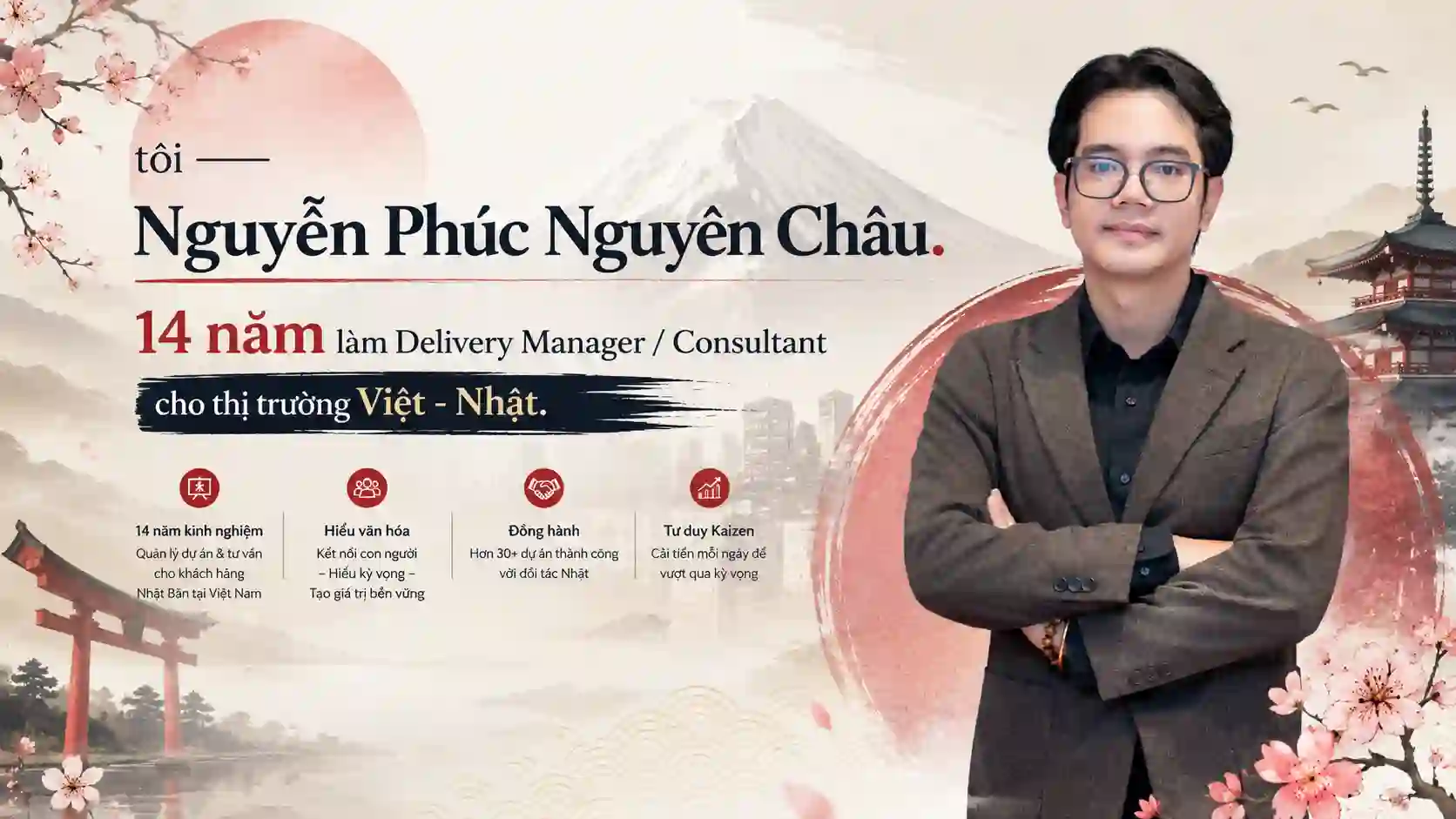
- Problem: Many software projects slowly die not from lack of good code but from lack of someone accountable for delivery.
- Solution: The perspective of a 14-year Delivery Manager in the Vietnam-Japan market, sharing real cases textbooks do not teach.
- Outcome: A blog for business owners who want to understand the essence of delivery rather than just hear technical jargon.
Hello there 👋
I am Nguyen Phuc Nguyen Chau — a Delivery Manager with 14 years in the trade. I started this blog for a simple reason: after 14 years of hands-on experience across dozens of software projects, I realized that the most valuable knowledge often isn't found in textbooks, and few dare to share it frankly — especially the "scars" earned in the trade.
TL;DR (Executive Summary)
- Problem: Many software projects slowly die not from a lack of good coders, but from the lack of someone accountable end-to-end — bridging the business problem with architecture and real-world operations.
- Solution: A Delivery Manager model where the same person both advises and builds, distilled over 14 years in the Vietnam–Japan market: no "lost in translation", final accountability, and an understanding of both the engineer's pain and the business goal.
- Outcome: A blog written from real-world "scars" — case studies, mistakes, and how I fixed them — for business owners and engineers who want to understand the essence of delivery rather than just hear technical jargon.
Delivery Manager
My positioning is "Delivery Manager". For me, this isn't a flashy marketing line; it's a necessary choice to ensure the highest project quality by personally taking accountability for every phase. (I unpack what this means in What is Japanese-standard Delivery Management?)
- Consulting & Management Phase: I directly gather requirements, analyze business problems, and design the overall architecture. I manage scope, timeline, and budget with precision.
- Engineering Phase: I still code, I still debug, and I still build systems from scratch. I handle infrastructure and ensure stable operations.
Why do I still code? Because I believe a true Manager must understand the pain of an Engineer, and a great Engineer must understand the business problem the client is trying to solve.
The "House Without a Toilet" Lesson
In 2018, I learned a lesson I will never forget. I was leading a high-stakes project. The client wanted features that would bring high value and generate revenue. At the time, I still had a "Robot" mindset: whatever the client requested, I delivered exactly as specified. I focused 100% on the paperwork requirements.
The result? The product was technically perfect according to the specs but... nobody used it and it made zero money.
That's when I realized: Client requirements are always incomplete. Clients are not software experts; they know what they want, but they don't always know what they need to succeed.
It's like a client asking you to build a beautiful house but forgetting to mention the bathroom. If you blindly follow the blueprints without adding a bathroom, where will the client go? You followed the requirements, but you built a useless product.
From "Robot" to "Value-Driven" Mindset
After that failure, my mindset shifted completely. Instead of waiting for orders, I put myself in the user's shoes to understand their true pain points.
Instead of saying, "The client didn't ask for it, so I didn't do it," I started proactively proposing solutions:
- "This feature should be modified this way to optimize conversion."
- "This process should be removed so users don't drop off halfway."
When you bring real value and real money to the client, your position changes from a "hired hand" to a Strategic Partner.
What will you find on this Blog?
I won't write about empty theories. This blog will focus on:
- Real-world Case Studies: Projects I've worked on, mistakes I've made, and how I fixed them.
- Manager Skills for Engineers: How to make sure your code doesn't just run, but makes money.
- Tech Skills for Managers: How to manage projects without being "fooled" by technical jargon.
- AI & Automation: How I used AI to cut 40% of operational costs (as I did for insurance projects).
If you are an Engineer looking to step up to Architect/Manager, or a Business Owner looking to understand the "underworld" of software better, I hope my shares will be helpful to you.
Thank you for visiting! Let's connect if we're on the same wavelength.
And if your website gets traffic but never converts, two free starting points: read why websites fail to generate leads and run the free website audit tool to see where your system leaks.
Nguyen Chau
Expert Delivery Manager / Delivery Manager
14+ Years of Professional Delivery Experience

Frequently Asked Questions
How is a Delivery Manager different from a Project Manager or Dev lead?
A Delivery Manager is accountable for the final operational outcome, not just schedule or code. The role connects business needs, system architecture, and end-to-end ownership so the solution actually works in reality.
Who is this blog for?
For SME owners and managers facing software, operations, or digital-transformation problems who want to understand how decisions are made rather than just hear technical terms.
