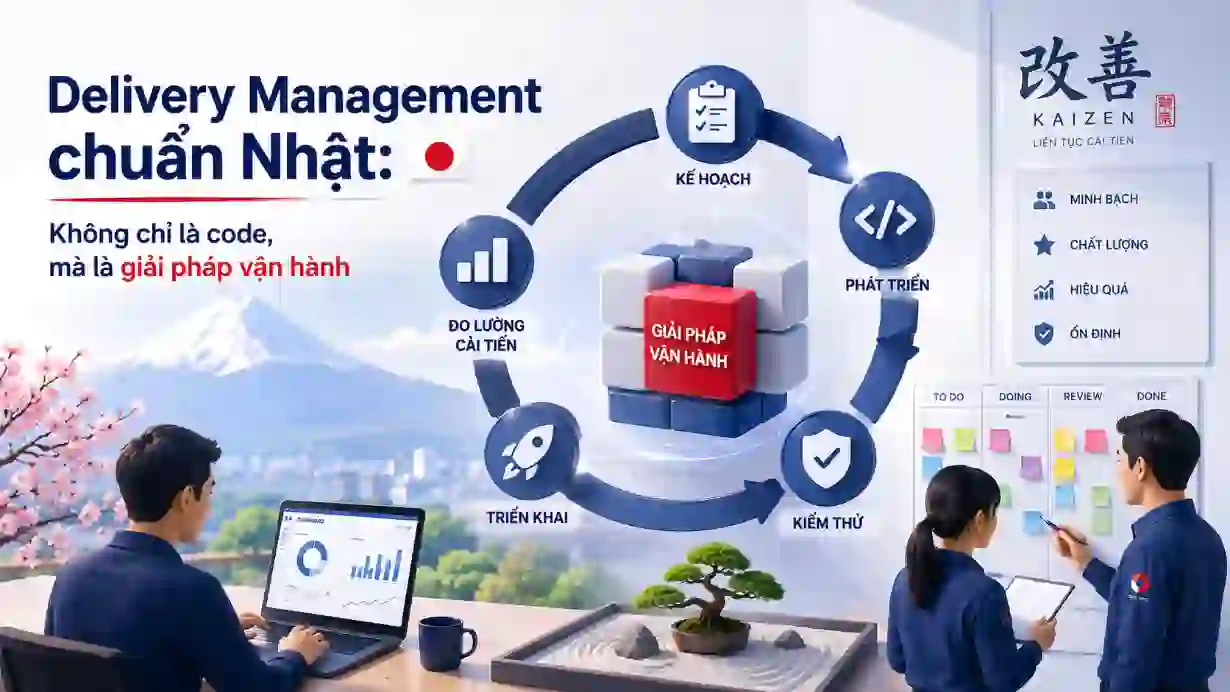
- Problem: Why do famously strict Japanese firms pay a premium for a Delivery Manager instead of just hiring outsourcing?
- Solution: Distinguish ordinary outsourcing from Delivery Management and clarify what Japanese-grade quality really means.
- Outcome: A way to tell when a business truly needs the "Japanese standard" and when it is overkill.
What is a Delivery Manager? The person ultimately accountable for a software solution being delivered as promised — not merely "code completed", but the right business problem solved and the system running stably in production. Unlike a Project Manager (schedule, resources), a Delivery Manager owns the outcome (accountability) of the entire solution, from architecture to healthy live operations.
In the IT industry, especially when working with the Japanese market, the keyword "Quality" is often treated as an obsession. But if you think quality simply means bug-free code, that's an incomplete perspective. After more than 14 years working as a Delivery Manager and System Architect for projects spanning Japan and Vietnam, I realized the core difference lies in how we view the final product.
TL;DR (Executive Summary)
- Problem: Traditional software outsourcing models only focus on writing code to spec, resulting in products that lack practicality and easily collapse when operational errors occur.
- Solution: Apply Japanese-standard Delivery Management with 3 core elements: thoroughly handling exception risks (Unhappy Path), ensuring error tracking (Traceability), and maintaining system architecture (Maintainability).
- Outcome: Delivery of a complete operational solution, sustainable business value, and a "Core System" capable of surviving real-world turbulence, making it a worthy investment for the business.
1. Standard Outsourcing vs. Delivery Management
Software Outsourcing
The most common model in Vietnam. The client hands you a Requirement (Spec). The development team writes code exactly according to that specification.
- Pros: Fast, usually cheap (see also: IT Freelancer vs. Agency).
- Cons: "If the client is wrong, the product is wrong." If the initial specification contains business logic flaws, the dev team will code those flaws into existence. Responsibility stops at the code layer — this is why most outsourced IT projects fail.
Delivery Management
This is an entirely different position. "Delivery" is not just handing over code; it's delivering business value. A Delivery Manager does not blindly follow the Spec. They push back and ask the client: "Why do you need this feature? What problem does it solve in your current operational process? If the user makes a mistake here, how should the system report the error so they don't have to call Customer Support?"
2. What is the "Japanese Standard" in Delivery?
The Japanese market does not tolerate operational risks. A minor system error can lead to staff having to apologize to customers, severely impacting brand trust. Therefore, the "Japanese Standard" in Delivery encompasses 3 rigorous elements:
A. Define the "Unhappy Path" (Risk Prediction)
A standard dev team only codes for the "Happy Path" (when everything goes smoothly: the user enters the correct info, network is fast, servers are up). A Japanese-standard Delivery Manager spends 50% of their architectural analysis time handling the "Unhappy Path":
- What if the network drops while the user is paying?
- If a Third-party API integration times out, what is the fallback flow? The system is never allowed to "freeze" without providing a reason.
B. Traceability
Every technical decision and data flow must leave a "trail". If a function fails 6 months down the line, we must be able to immediately query the System Logs to find the root cause. Building a robust Logging and Monitoring system from day one is a mandatory principle.
C. Maintainability
The Japanese think long-term. They don't want a system that runs well for the first month and then requires a complete rewrite with every update. The System Architecture must be designed so that a new programmer joining the project can read the code and quickly understand the logic. Clarity in Database Design and Code Structure is paramount.
3. Not Every Company Needs the "Japanese Standard"
Of course, everything comes at a price. Applying Japanese delivery standards requires longer analysis time and higher architectural costs. If you are building a campaign Landing Page that runs for 2 weeks and then gets discarded, you do not need the Japanese standard. Just pick the cheapest and fastest option. But if you are building a Core System, an internal operational platform used by dozens of staff, or an E-commerce website that serves as your business's primary revenue stream... then compromising on a patched-up architecture will be a slow death sentence for your growth.
Do you need someone to take full accountability from A to Z, directly architecting and managing your software project to the strictest standards to ensure your system survives operational turbulence? Submit your system case to me. Or, you can view my real-world project case studies and read the 4-year case study delivering a Japanese MEO SaaS for 90,000 stores to see this standard operating for real.
Nguyen Chau
Delivery Manager / System Architect
14 years of experience delivering architecture and systems for the VN-JP market

Frequently Asked Questions
What is a Delivery Manager?
A Delivery Manager is the person ultimately accountable for a software solution being delivered as promised — not just "code that runs", but a solution that solves the right business problem and operates stably. Unlike a Project Manager, who focuses on schedule and resources, a Delivery Manager owns the final outcome of the entire solution.
How is Delivery Management different from ordinary outsourcing?
Outsourcing delivers code to spec; Delivery Management is accountable for the operational solution and final quality. The difference is end-to-end ownership, not how many lines of code get written.
Does every business need the "Japanese standard"?
No. The Japanese standard pays off when failure risk is high, operations are complex, or quality requirements are strict. For small, simple projects it can raise cost without adding proportional value.
