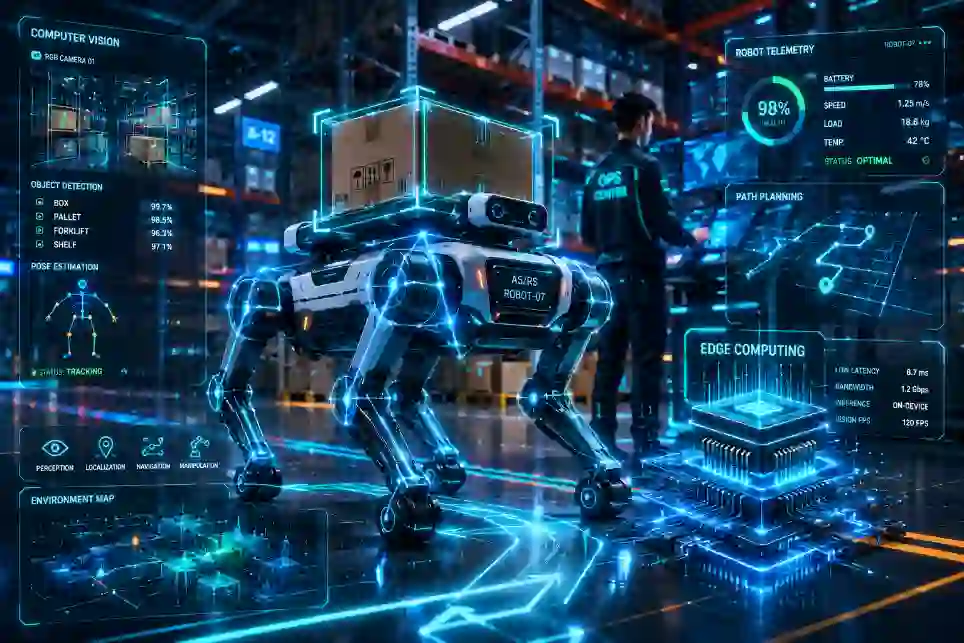
Short answer: Applying AI to physical operations (like logistics warehouses or sports) requires processing data directly at the endpoint device (Edge AI) with millisecond latency, rather than pushing data to the cloud (Cloud AI) like standard Chatbot systems.
TL;DR (Executive Summary)
- The problem: In a service/logistics robot project, robots needed to identify obstacles in complex warehouses. In a GolfSwing Analysis project, the system needed to analyze player movements with ultra-low latency for real-time feedback.
- The solution: I used recognition models (YOLO) for Path Optimization for the robots; and used MediaPipe/OpenCV for skeletal pose analysis in Golf. Both deployed an Edge AI architecture running directly on hardware devices.
- The result: Robots operated safely, dodging obstacles and optimizing routes in warehouse environments. The Golf system was packaged into a Commercial Product and successfully demonstrated at a technology exhibition in Japan.
What is Edge AI? The Difference Compared to Cloud AI (ChatGPT)
When AI is mentioned, most business owners think of Chatbots (LLMs) — input text, and AI replies. This is Cloud AI: Your data is sent to massive servers at OpenAI/Google, processed, and the result is sent back.
However, from a System Architecture perspective, Cloud AI is helpless in real-time physical operations. A robot driving through a warehouse cannot wait 2 seconds for the Cloud to return a "there is an obstacle ahead" result — it would crash into the shelves.
Edge AI (AI at the edge) is the solution: The AI model (like YOLO, Computer Vision) is compressed and run directly on the chip embedded inside the Robot, or the Camera in the factory. The trade-off here is: You use the limited computing power of local hardware in exchange for low latency (no waiting on a network round trip) and image data that never has to leave the device.
From Logistics Robots to Golf Swing Analysis
In the Robot AI Training project, the core problem was Object Detection. By training a YOLO model on specialized warehouse datasets, the robot didn't just learn to "avoid obstacles" but also performed Path Optimization, minimizing the time the robot stood waiting or took detours.
For the GolfSwing Analysis project, the system utilized Computer Vision technology via MediaPipe and OpenCV (Python). The AI tracked dozens of skeletal joints on the player's body in real time. Any deviations in swing angle or hip posture were calculated and reflected instantly on the screen (Real-time Feedback). Low latency was the deciding factor in successfully packaging this into a commercial product showcased in Japan.
Unstructured data (Images, Video, Spatial coordinates) is the true goldmine for optimizing operational costs, not just textual data.
Chatbots are just the tip of the AI iceberg. If your enterprise needs to optimize physical operational workflows (QA/QC, Logistics, smart security cameras), check out my AI Automation capabilities or connect with me to design a tailor-made system.

Frequently Asked Questions
How is Edge AI different from Cloud AI like ChatGPT?
Edge AI runs the model on the local device, giving low latency and no network dependency, ideal for cameras, robots, and sensors. Cloud AI excels at large-scale language tasks but must send data to a server.
What operational tasks can Computer Vision handle?
Warehouse robot routing, visual quality inspection, object counting and tracking, and motion analysis such as in sports. The common thread is turning images into real-time decision data.
What is the biggest difference between Cloud AI and Edge AI in manufacturing?
It's Latency and Internet Dependency. Inside factories, Wi-Fi networks are often unstable due to interference from mechanical machinery. Edge AI keeps a Quality Assurance (QA/QC) camera checking product appearances running normally even if the Internet completely goes down, with response times of just a few milliseconds. Note: accuracy is a property of the model and its training data, not of running at the edge versus in the cloud — Edge AI removes the network dependency, not the model's error rate.
Does deploying Edge AI require investing in massive servers?
No. Edge AI architecture is designed to run on specialized, inexpensive, and low-power Edge devices, such as Nvidia Jetson Nano, Raspberry Pi combined with AI accelerators, or AI cameras with built-in NPU chips. Hardware costs are vastly cheaper than renting Cloud GPUs monthly.
